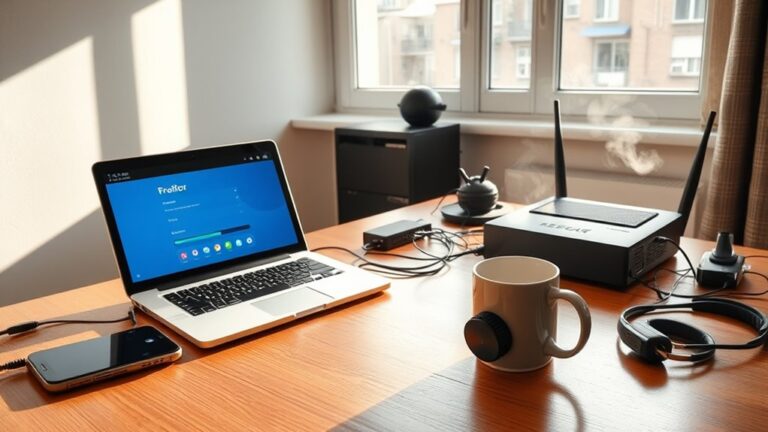

Pick a VoIP provider that fits your needs (RingCentral for control, Nextiva for CRM, Dialpad for AI, Zoom Phone for video). Get SIP phones or softphones, a QoS-capable router, PoE switches, and business-grade internet. Budget 100 Kbps per call plus 20–30% overhead. Use Ethernet, open SIP/RTP ports, and enable QoS, VLANs, and traffic shaping. Aim for latency <90 ms, jitter <30 ms, packet loss ~0%. Run test calls, monitor, and tune—there’s more you can do next.
Key Takeaways
- Choose a VoIP provider based on features you need (RingCentral, Nextiva, Dialpad, Zoom Phone are strong options).
- Ensure reliable internet: fiber or business-grade, latency <150 ms, jitter <30 ms, packet loss <1%.
- Budget bandwidth: at least 100 Kbps per voice call plus 20–30% overhead; prefer wired Ethernet over WiFi.
- Use compatible hardware: SIP phones or softphones, QoS-capable router, PoE switches, and optional analog adapters for legacy phones.
- Configure network: enable QoS and VLANs, open SIP/RTP/STUN ports (e.g., 5060, 5004, 3478–3479, 16348–32768), then test calls during peak hours.
Choose the Right VoIP Provider
Which provider fits your workflow and budget? Start with your use case and map it to a telephony feature set. Need enterprise-grade control and global reach? RingCentral delivers multi-level IVR, queues, AI noise reduction, 99.99–99.999% uptime, and long-term savings (~12% TCO over three years). It also offers global PSTN support spanning 46 countries with local numbers in 99, making it suitable for distributed teams.
Prioritize automation and CRM? Nextiva’s auto-attendants and built-in CRM fit sales teams. Want strong AI at competitive pricing models? Dialpad’s real-time transcription and data capture stand out. Rely on video? Zoom Phone integrates natively with HD quality. International calling heavy? GoTo Connect includes unlimited minutes to 50+ countries.
On a tight budget? Phone.com starts near $12.74/user/month with 50+ standard features. Small teams mobile-first? OpenPhone (Quo) excels. Fastest solo setup? Grasshopper or Ooma for plug-and-play simplicity.
Gather the Necessary Equipment
Start by selecting VoIP-compatible hardware—SIP phones, ATAs, or softphones—and confirm support for your provider’s codecs and features. Add a modem and router to connect to your ISP and direct data packets within your network. Prefer wired Ethernet with QoS-capable routers and PoE switches; it cuts latency and packet loss versus Wi‑Fi. Guarantee bandwidth headroom: budget ~100 Kbps per call in each direction plus 20–30% overhead, and use business-grade, stable internet.
Choose Compatible Hardware
Before you buy anything, match your hardware to VoIP’s real network demands: budget at least 100 kbps per concurrent call (512 kbps recommended) with upstream capacity and sub‑150 ms latency. Proper hardware is the foundation for reliable VoIP calling, and your local infrastructure determines call quality and user experience. Validate router capabilities first: insist on business‑grade QoS, SIP handling, VLANs, traffic shaping, and an enterprise firewall. These directly protect voice quality under load.
Select endpoints by role. Use VoIP desk phones with Ethernet for staff; pick models with larger displays if you need advanced features. Deploy conference phones for rooms. If you prefer apps, choose reputable softphones and pair them with noise‑canceling headsets.
Build the switching layer with managed switches supporting PoE, packet classification, and dedicated voice VLANs over Cat5e/Cat6. Add analog adapters or gateways only if legacy phones must stay. Include battery backups for continuity.
Prefer Wired Connections
You’ve matched hardware to VoIP’s network demands; now prioritize wired paths and gather what makes them reliable. Build a robust cabling strategy around CAT5e or CAT6; choose CAT6 where you want >100 Mbps headroom and future-proofing. Terminate runs to standard RJ45 jacks at every workstation. Favor professional installation—CAT6 benefits from certified technicians—to protect physical infrastructure integrity, proper routing, and clean terminations. Note that regular telephone wire (Cat3/RJ11) does not support VoIP services and should not be used for these deployments.
Deploy PoE. Use PoE switches or injectors so each VoIP phone receives data and power on one cable, reducing wall warts and centralizing power management. PoE stabilizes delivery during electrical fluctuations, protecting call quality.
Select business-grade routers and quality switches with VLAN, firewall, QoS, and traffic-shaping capabilities. Verify modem/router compatibility with your VoIP provider. Label and document cable runs, then test every drop before you cut over.
Ensure Sufficient Bandwidth
Even with pristine cabling, VoIP only works as well as the bandwidth behind it, so size your pipe and gear to your peak call load. Plan a bandwidth provisioning strategy: budget ~100 kbps per voice call each way, 384 kbps–2 Mbps for video, and don’t ignore upload. Choose fiber with an SLA (99.9%+ uptime) when calls are business-critical. Use business-grade routers with QoS, VLANs, and traffic shaping to prioritize voice. Business-grade internet often includes SLAs and QoS that ensure reliable connectivity and prioritized voice traffic.
- Calculate concurrent call capacity by codec; multiply by per-call bandwidth and add 20% headroom.
- Run quality metrics testing: latency (<150 ms), jitter (<30 ms), packet loss (<1%).
- Stress test during peak hours; monitor continuously to adjust policies.
- Equip PoE switches, SBCs, and LTE failover for resilience and clean routing.
Check Your Internet and Network Requirements
Although VoIP is flexible, it’s unforgiving about network quality, so verify your internet and LAN meet hard limits before rollout. Start with facts: latency <90 ms, jitter <30 ms, packet loss ~0%, RSSI ≥ -60 dBm. Use Speedtest.net at desks during peak load. Upload matters as much as download. Use the formula: Upload (Mbps) × 1000 ÷ 445 to size max lines. Identify network bottlenecks and Establish QoS policies so voice preempts bulk traffic. Also, ensure you use wired Ethernet where possible because it is preferred over WiFi for VoIP reliability.
- Use business‑grade routers (Cisco Linksys recommended); open ports 5060 TCP/UDP, 5004 UDP, 3478–3479 UDP, 16348–32768 UDP.
- Prefer wired Cat5e/6; deploy multiple APs if you must use Wi‑Fi.
- Monitor continuously; shape bandwidth to prioritize RTP.
| Metric | Target |
|---|---|
| Latency | <90 ms |
| Jitter | <30 ms |
| RSSI | ≥ -60 dBm |
Connect and Position Your Hardware
Before dialing a single test call, map the physical path: run Ethernet (RJ‑45) from each VoIP desk phone or ATA to a switch, prefer PoE to cut power bricks, and home-run dedicated lines to a business‑grade router. Seat desk phones within reach, not beside monitors or power supplies. Place conference units centered on tables. Mount routers/switches in ventilated racks; label and Velcro cables. Use surge protection and put PoE switches, router, and modem on battery backup.
Position wireless access points with smart external antenna placement; prioritize line-of-sight and ceiling mounts. For reliable performance, configure router QoS to prioritize VoIP traffic over other data.
Execute wireless interference mitigation: separate channels, 5 GHz for voice, and keep APs from microwaves and cordless bases.
Deploy DECT for cordless sets; avoid Wi‑Fi congestion.
Integrate ATAs, VoIP gateways, and fax adapters as needed.
Configure Your VoIP Service Settings
Start by bringing each endpoint online and proving registration, then harden routing and quality. Enter the SIP server/proxy exactly as provided (e.g., sip3.voipvoip.com), username as your number, and the exact authentication password. Use port 5060 unless your provider says otherwise. Confirm status shows REGISTERED. Enable DHCP; if unavailable, set static IP (e.g., 192.168.1.2) with correct subnet, gateway, DNS host name. Access the device web UI at its IP to verify. Note that when prioritizing voice, ensure your network supports multiple CoS flows so voice traffic is prioritized over data.
Create service objects for VoIP ports, group as “VoIP Services,” and apply VoIP security configurations. Build WAN-to-VoIP access rules with destination as the WAN interface IP. For NAT, check reflexive policy for VoIP. Align SIP Transformations to PBX placement (external: enable; same firewall: disable). Activate the provider profile and keep a SIP account backup.
| Item | Setting | Target |
|---|---|---|
| SIP Reg | 5060/REGISTERED | Provider |
| Lines | 3/4 | Profile |
| IP Prec | Voice priority | Network |
Optimize Your Router for Call Quality
You’ve proven registration and secured routing; now tune the router so calls stay clean under load. Lock in a static IP configuration for the VoIP gear, avoid double-NAT, and prefer ethernet backhaul for every stationary phone. Use a business-grade router with native SIP support, jitter buffers, and CPU headroom for encryption plus traffic management.
Set QoS: reserve 100 kbps per HD call, prioritize DSCP 46, and enter real measured up/down speeds—never overstate. Public internet generally does not honor QoS end-to-end, so focus on LAN and ISP edge controls.
Segment voice: put phones on a dedicated VoIP VLAN; keep streaming and backups off that lane.
Favor wire: ethernet beats Wi‑Fi; if wireless, place radios well and use wired mesh nodes.
Plan bandwidth: count max concurrent calls; upload is the limiter. QoS only guarantees quality on your LAN.
Test Calls and Fine-Tune Performance
Once phones register and routes are secure, run controlled test calls and measure the basics: latency (<150 ms), jitter (<30 ms), packet loss (<1%), and per-call bandwidth (~100 Kbps). Use test call quality metrics across per-flow paths, baseline references, and bulk call simulations to expose weak links. Record RTP Max/Min Trip Time to spot round-trip variability. To ensure robustness, incorporate load testing principles by simulating concurrent call volumes that mirror peak usage patterns and analyzing key metrics to identify bottlenecks.
If metrics drift, fine tune bandwidth allocation: target 100 Kbps per call, 500 Kbps for 5, 1 Mbps for 10. Prioritize RTP with QoS, then verify by repeating tests across business hours. Adjust codecs (G.711 vs. G.729) and buffers to absorb jitter without bloating delay. Monitor CDRs, MOS, and continuous packet-loss graphs. Validate SRTP performance, compare IPv4/IPv6, and run soak tests to confirm stability.
Frequently Asked Questions
Can I Keep My Existing Phone Number When Switching to Voip?
Yes. With phone number portability, you can keep your number if provider compatibility and geographic rules align. Submit a recent bill, LOA, account/PIN, and matching billing details. Keep service active; porting takes 5–10 business days with temporary routing.
How Do Emergency 911 Calls Work Over Voip at Home?
Your 911 call routes to the PSAP using your registered address for emergency responder location and call-back. You must keep it updated. Expect emergency call reliability issues during power/internet outages; test routing periodically and maintain a backup communication method.
What Happens During a Power or Internet Outage?
Your VoIP stops when power or internet fails. Use backup power sources (UPS/batteries) to keep modem/router/ATA alive. Expect degraded quality. Prioritize alternative communication methods: cellular voice, LTE hotspot, or apps. Verify 911 availability; providers’ infrastructure and service types differ.
Are There Privacy or Eavesdropping Risks With Voip Calls?
Yes. You face encryption vulnerabilities and call monitoring concerns: unsecured Wi‑Fi (24%), providers not defaulting to encryption, packet sniffing, MITM, spoofing, vishing, malware. Mitigate with SRTP/TLS, WPA3, VPN, device hardening, MFA, call authentication (STIR/SHAKEN), and staff training.
How Do I Block Spam or Robocalls on Voip Lines?
Enable STIR/SHAKEN, SRTP/TLS, and carrier spam filters. Activate device features. Use IVR. Install Hiya or CPR V5000. Configure firewalls/IDS. Maintain caller ID reputation. Blacklist unwanted numbers, silence unknown callers, and report spam calls to regulators and providers.
Conclusion
You’ve got the plan—execute it. Pick a VoIP provider with proven uptime and low jitter. Buy gear that supports SIP and QoS. Verify internet speed (≥25 Mbps down, ≥5 up), latency (<50 ms), jitter (<30 ms), packet loss (<1%). Wire key devices via Ethernet. Enable QoS, SIP ALG off, VLAN if supported, DSCP 46. Configure codecs (Opus/G.711), E911, and call routing. Run test calls, capture MOS scores, fix bottlenecks, and document settings for repeatable reliability.